Executive Summary (Field Intelligence): Most businesses mistakenly set sales quotas based on what their factory or current capacity can comfortably produce, trapping themselves in incremental 10% annual growth. When facing aggressive competitors or managing short cash runways in crisis economies, capacity-based planning is fatal. By applying the JFK Moonshot Principle, establishing an ambitious commercial target first and reverse-engineering the necessary capital, headcount, and trade marketing, operators can force capabilities into existence, capture competitor strongholds, and achieve leapfrog growth.
What happens when factory capacity dictates sales ambition?
In 2011, I stepped out of general trading and into my first FMCG company.
I was 26 years old, stepping into an Executive Director role. The business sold liquor, splitting the portfolio between high-end bottles and low-end spirits. High-end was quiet. Low-end was a bloodbath.
A bottle cost around 3,000 kyats. The market was crowded, unforgiving, and cutthroat. In that space, you either take your competitor’s territory or get crushed on your own turf. Rapid expansion was not an aggressive choice. It was pure survival.
Yet we were trapped in a slow bleed. We had barely 10% year-over-year growth, selling the exact same volume into the exact same sliver of market share.
Our bottleneck was not the market. It was our own thinking.
We were setting our sales targets based on what the factory told us they could produce. We spent every quarter balancing production capacity against sales quotas. We let the machines dictate our ambition.
What can commercial operators learn from JFK's 1961 moonshot speech?
One afternoon in my office, I read an article about John F. Kennedy and the space race. In May 1961, JFK stood before a joint session of Congress and delivered the moonshot mandate:
"I believe that this nation should commit itself to achieving the goal, before this decade is out, of landing a man on the moon and returning him safely to the Earth."
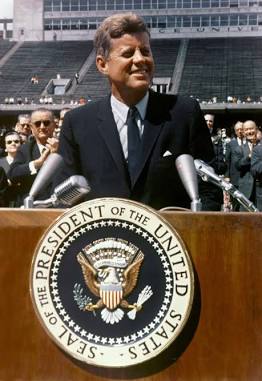 JFK at Rice University, 1962. Source: Wikipedia
What surprised me was the author's note: "When he spoke those words, NASA did not have the answers. They did not have the Saturn V rockets, the lunar spacesuits, the lunar module, or even the basic orbital mechanics required to dock two spacecraft in orbit."
The goal did not wait for the tools. The goal forced the tools into existence.
That single insight broke my mental ceiling.
How did an FMCG liquor brand conquer Hlaing Thar Yar?
I walked into our next executive directors meeting and put it on the table. I told the board we were done letting factory capacity choke our commercial growth. From that day on, the target came first. The resources would follow the target.
We set an audacious target right in that room: double our sales volume and double our geographic territory in 12 months.
We picked the strongest fortress of our biggest competitor: Hlaing Thar Yar township. We decided to take it.
 Sai Han Linn (Center) with the Executive FMCG Sales Team in 2011.
We hit the field. Within a year, we captured the dominant market share in Hlaing Thar Yar. The momentum snowballed across the entire country. We grew so fast that our warehouse could no longer contain the volume.
Field Data Evidence: Within 12 months of targeting Hlaing Thar Yar directly, our field team captured dominant market share in the township. Nationwide demand surged to the point where wholesaler trucks were forced to queue along the highways outside Yangon because warehouse loading bays were operating at absolute capacity.
How does reverse-engineering sales targets apply to crisis management?
That psychological shift stayed with me throughout my career.
When I moved to another organization facing massive credit risk, we used the same mindset. We set the target first. Within two years, we flipped the entire operation from 98% consignment sales to 90% upfront cash-down sales.
When I launched my own sales transformation firm in 2019, I brought this exact principle to every founder I advised.
Whenever I sit down with a founding team, my first question is never about their current capacity or budget. My first question is simple:
"What do you actually want to hit? How much do you need to sell?"
Only after the target is locked do we reverse-engineer the machinery. The headcount, the trade marketing, the key account spend, and the cost of goods sold are simply math problems designed to serve the target.
Why is incrementalism fatal when runway is short?
Operators often fall in love with the comfortable illusion of incrementalism. They tell themselves they will work with what they have, grow slowly, and serve a small base of loyal buyers. In peacetime, with deep cash reserves, that approach works fine.
In crisis, when we have three months of runway left to survive, backward-looking capacity planning is fatal.
Setting the audacious target first is what creates leapfrog momentum. It is how my clients have grown from six figures to seven figures in 12 months, scaled from a solo operator to over 300 staff, and expanded from a single market across three countries.
Target first. Resources follow.
Frequently Asked Questions (FAQ)
Why should a company set sales targets before securing resources?
Setting targets based on existing resources caps growth to current capacity and prevents the business from responding to aggressive market competition. Setting the target first forces the team to identify, source, and deploy the exact operational resources required to win.
What is the JFK Moonshot Principle in business?
It is the strategy of committing to an ambitious, non-negotiable objective before all technical and operational solutions exist, using the gravity of the goal to drive the creation of necessary capabilities.
How does this framework apply to crisis economies?
In volatile or crisis environments with short cash runways, incremental planning leads to stagnation and failure. Audacious, reverse-engineered targets allow operators to capture high-margin market share rapidly and secure vital cash flow.